The Bolt-On Problem: Why Deploying AI on Top of Existing Workflows Makes Things Worse Not Better
Tell us about your team and we'll show you the path forward.
We'll be in touch.
Our team will reach out within 24 hours.

There is a pattern in enterprise AI that almost no one talks about openly, because it is uncomfortable to admit.
AI was deployed. Teams started using it. The work got harder.
Not harder because the tools are difficult. Harder because the workflows underneath didn’t change. Teams are now managing both the old process and the new tool — running two systems in parallel where one was designed to be enough.
The World Economic Forum’s 2026 AI at Work report documented this precisely: deploying AI without redesigning the workflows it enters creates more work instead of less. It is not a fringe finding. It is a description of what most enterprise AI programmes are producing right now.
Bolt-on AI is what happens when an organisation adds AI to a workflow without changing the workflow.
The approval process still requires the same sign-offs. The reporting cadence is still weekly. The brief still needs to go through three people. AI is inserted somewhere in the middle — usually in the drafting, summarising, or formatting steps — and the structure around it stays exactly as it was.
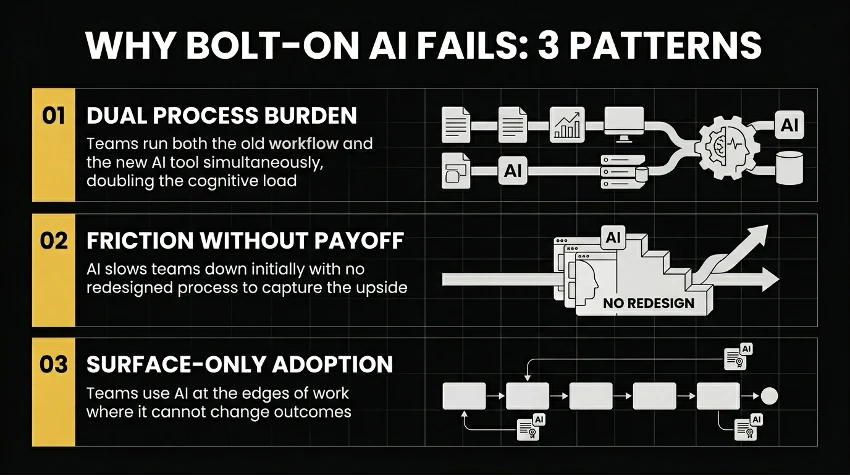
In theory, this should produce time savings. In practice, it produces three specific problems:
Workers now run the old process and the new tool. They review AI output, apply the same old review criteria, and reformat everything to fit the existing system. The AI adds a step; it doesn’t remove one. Cognitive load rises.
Early AI use is inherently slower. Learning any tool takes time. When the workflow underneath hasn’t changed, that initial slowdown has no upside to compensate for it. Teams experience AI as overhead — not leverage.
When AI creating friction rather than relief pushes teams back, people rationally restrict where they use it. They keep it at the edges of work — low-stakes, low-visibility tasks where the cost of a mistake is minimal. AI never reaches the work that actually drives output.
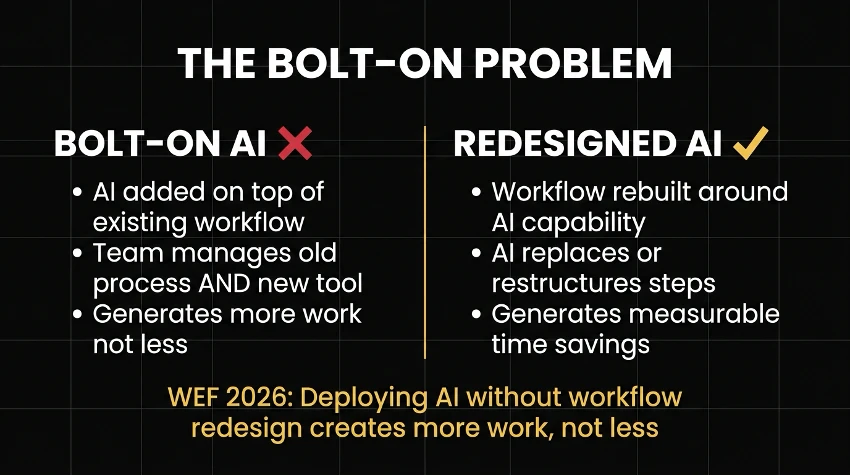
Bolt-on AI is the default for a specific reason: it requires no change management.
Redesigning a workflow requires leadership alignment, process mapping, capability building, and a change programme that touches multiple teams. That is hard, slow, and politically complex. Adding AI on top of an existing workflow requires none of those things — just a licence and an announcement.
Deloitte’s 2026 State of AI research quantifies the result: 37% of companies are using AI at a surface level with no change to existing processes. Only 34% are genuinely reimagining how work is done. The rest — the majority — are in the bolt-on zone: deploying tools into unchanged structures and measuring adoption rather than impact. This is what workflow redesign before AI deployment prevents.
This is not a failure of ambition. It is a failure of sequencing. The tools came first. The workflow redesign was postponed — and for most organisations, it never happens.
The organisations generating real value from AI make a different choice before deployment begins. They do not ask: how do we add AI to this process?
They ask: if we were designing this process today, knowing what AI can do, what would it look like?
That is a fundamentally different question. It requires suspending the existing workflow long enough to see it clearly — which steps exist because of genuine necessity, and which exist because of legacy constraints that AI can remove.
The output of that question is a redesigned workflow: one where AI does not add a step but changes the structure of the process entirely. Review cycles get shorter. Handoffs get eliminated. Decision points shift. The AI is built in, not bolted on.
Four things happen when workflows are redesigned first:
• AI reduces time-on-task rather than adding to it
• Workers adopt AI at depth because it makes the redesigned process work — not because they were told to use it
• Output quality improves alongside speed because the workflow itself was improved
• Measurement becomes meaningful: cycle time, rework rate, and decision speed all move
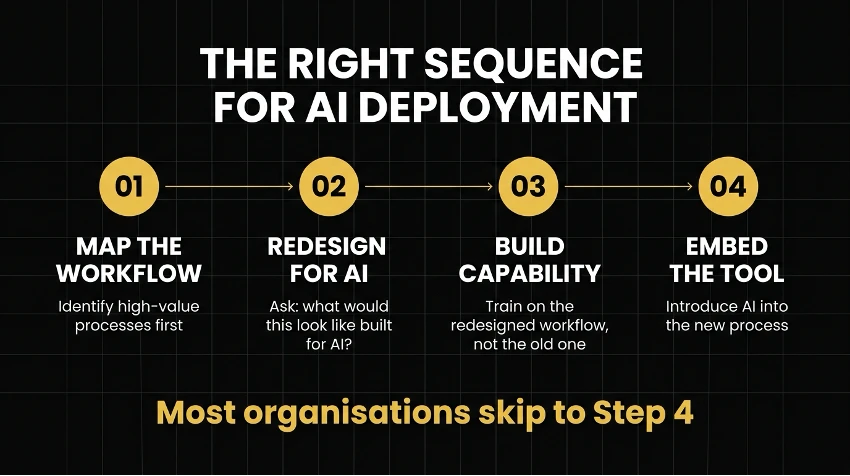
Workflow redesign is not an IT project. It is a leadership decision.
It requires someone to be accountable for the answer to: does this workflow still make sense? That question will surface inefficiencies, expose redundant roles, and challenge assumptions that have been comfortable for years. It is not a comfortable process. Which is why most organisations skip it.
The organisations that do it well treat workflow redesign as the first act of an AI programme — not a later phase. They involve the people who run the process in the redesign. They build capability on the new workflow, not the old one. And they measure results from the workflow, not from the tool.
The consequence of skipping this is already visible across the enterprise landscape: high AI investment, high usage rates, and an honest performance delta that most organisations don’t want to measure.
→ Talk to Humaine about workflow-integrated AI enablement for your team
Because the workflow structure doesn’t change. Teams end up managing both the old process and the new tool. AI adds a step before the existing review, formatting, or approval process — it doesn’t replace it. The cognitive load increases without proportional benefit.
Workflow redesign means rethinking a process from the ground up with AI’s capabilities in mind, rather than inserting AI into an existing structure. It matters because AI’s value comes from changing how work is done, not just speeding up individual steps within an unchanged process.
Look for these signs: teams describe AI as extra work rather than time-saving; AI use is concentrated in low-stakes tasks; workflow cycle times haven’t changed despite AI adoption; managers report that the way the team works is essentially the same. Any of these indicate bolt-on AI.
Map the current workflow and identify which steps exist because of genuine necessity versus legacy constraint. Redesign the workflow with AI’s capabilities built in from the start. Build team capability on the redesigned process. Then introduce the tool into the new structure — not the old one.
The bolt-on problem is not a technology failure. The tools are capable. The failure is in how they are deployed.
Inserting AI into an unchanged workflow produces a predictable result: more steps, more complexity, and a team that rationally keeps AI at the periphery of their real work. The performance improvement never arrives. The usage metrics look fine. The work hasn’t changed.
Fixing this requires doing the harder thing first: redesigning the workflow before the tool goes in. It is slower to start and much faster to deliver. And it is the only path from AI deployment to AI value.