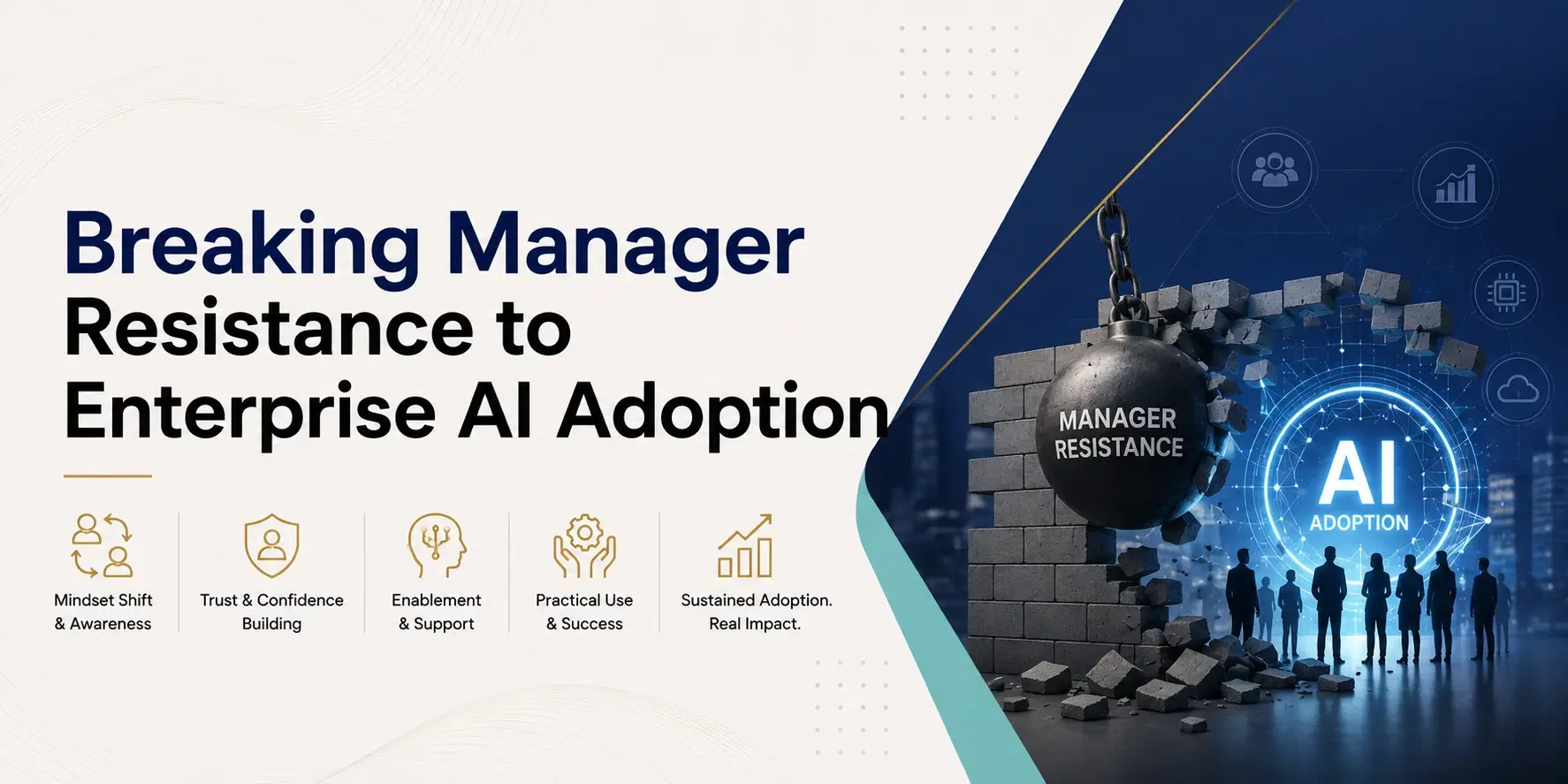
Breaking Manager Resistance to Enterprise AI Adoption

Tell us about your team and we'll show you the path forward.
We'll be in touch.
Our team will reach out within 24 hours.
74% of enterprise AI deployments fail to scale beyond pilot stage, despite global AI spending surpassing $301 billion. The culprit isn't technology, data quality, or budget constraints. It's middle managers—the very people responsible for translating C-suite AI enthusiasm into ground-level execution. While leadership champions AI transformation and individual contributors experiment with ChatGPT, managers actively resist adoption through a combination of identity threat, capability anxiety, and misaligned incentives that quietly derail even the most promising initiatives.
Most organizations treat manager resistance as a change management afterthought, assuming that awareness training and executive mandates will overcome operational inertia. They're wrong. Manager resistance operates as a sophisticated immune system that neutralizes AI adoption while maintaining plausible deniability. Understanding this dynamic—and the specific mechanisms through which it operates—is the difference between joining the 74% of failed deployments and building genuine AI capability that compounds across the enterprise.
TL;DR
Manager resistance, not technology barriers, causes 74% of enterprise AI deployments to stall—despite massive investment and C-suite support, middle managers create systematic bottlenecks that kill adoption
Five root causes drive this resistance: identity threat from AI capabilities, capability gaps disguised as skepticism, misaligned performance incentives, workflow control anxiety, and lack of peer-validated proof
Traditional training approaches amplify rather than solve the problem—generic workshops create awareness without capability, leaving managers more anxious and resistant than before
Regional patterns reveal different resistance mechanisms—hierarchical deference in India, talent poaching in Southeast Asia, and compliance anxiety in the US require distinct intervention strategies
Function-specific upskilling on real work, combined with leadership alignment on incentives, converts resistance into advocacy—but only when managers co-create new workflows rather than having them imposed
When Deloitte surveyed enterprise managers across finance, supply chain, and marketing functions in 2025, they discovered something telling: the managers reporting highest anxiety about AI weren't in the roles most likely to be automated. They were in functions where AI's capabilities were most visible and impressive. Finance managers watched AI generate complex analyses in minutes. Supply chain leaders saw AI optimize routes they'd spent years perfecting. Marketing directors observed AI create campaigns that outperformed their team's best work.
The threat wasn't job displacement—it was expertise displacement. These managers had built their authority on domain knowledge, decision-making judgment, and process optimization. AI didn't just threaten to do their work; it threatened to do their thinking. Harvard Business Review's November 2025 analysis captured this precisely: "Fear of replacement, rigid workflows, and entrenched power structures quietly derail AI initiatives, even in companies with advanced tools."
This explains why manager resistance often manifests as technical skepticism rather than career anxiety. Questioning AI's reliability or applicability feels more professional than admitting fear of obsolescence. But the skepticism reveals itself as capability anxiety when managers consistently avoid hands-on AI experimentation while demanding extensive proof of concept studies.

The resistance becomes systematic when these managers control team workflows, training budgets, and performance evaluations. They don't need to explicitly forbid AI adoption—they simply fail to prioritize it, allocate time for it, or adjust processes to accommodate it. The result is what ISG's 2025 report identified: pilots that generate impressive demos but never integrate into daily operations.
The identity threat creates a secondary problem that's even more insidious: managers who lack AI literacy cannot effectively evaluate AI opportunities, direct AI implementation, or integrate AI outputs into their decision-making processes. But admitting this capability gap feels like confirming their obsolescence fears. So the gap disguises itself as strategic caution.
Wharton's February 2026 study on AI adoption revealed this pattern across multiple enterprises. Managers would attend AI workshops, complete digital training modules, and even participate in pilot programs. But when asked to identify specific use cases for their teams or modify existing workflows to incorporate AI, they consistently defaulted to "we need more research" or "our use case is too complex." The real issue wasn't complexity—it was that two hours of digital content cannot build the hands-on capability required to confidently direct AI integration.
This capability-skepticism cycle becomes self-reinforcing. Managers who cannot effectively use AI tools naturally encounter more failures and edge cases, confirming their skepticism. They then share these negative experiences with peers, creating a network effect that spreads resistance across the organization. AI Assembly Lines' May 2026 analysis found this pattern in 67% of stalled enterprise deployments: initial enthusiasm followed by a cascade of "it doesn't work for our specific situation" feedback from the manager layer.
The most damaging aspect of this dynamic is that it appears rational from the outside. Managers citing specific technical limitations or workflow incompatibilities sound more credible than managers expressing career anxiety. Leadership often responds by investing in more training or better tools, missing the fundamental issue: the managers need to build confidence through successful hands-on experience, not consume more theoretical content.
Even managers who overcome identity threats and capability gaps face a structural problem that makes AI resistance economically rational: they're measured on quarterly KPIs tied to existing workflows, with no adjustment for the productivity dips that accompany AI adoption. Learning new tools, redesigning processes, and training teams creates short-term performance hits that show up in the next review cycle. The long-term productivity gains from AI adoption accrue to the organization, but the short-term costs hit individual manager performance metrics.
This misalignment explains why AI adoption often stalls after initial pilots show promise. Managers participate enthusiastically when AI adoption is positioned as an experiment or innovation project. But when it comes time to integrate AI into their team's daily operations—affecting their quarterly numbers—rational managers protect their performance reviews by maintaining existing workflows.
The problem compounds in organizations with strong performance cultures. High-performing managers have the most to lose from experimentation that might impact their track record. They're also the managers whose teams would most benefit from AI adoption and whose success would most influence peer adoption. ISG's 2025 research found that enterprises without dedicated change management budgets for AI were 3.2 times more likely to report stalled initiatives, precisely because they failed to address this incentive misalignment.
The performance trap creates a particularly vicious cycle in hierarchical organizations common in India's FMCG sector. Middle managers defer to senior leadership on technology decisions but resist implementation that might impact their performance metrics. They attend workshops and express support in leadership meetings while quietly maintaining existing workflows with their teams. Senior leadership sees compliance and assumes adoption, missing the passive resistance that prevents behavior change.
The deepest source of manager resistance emerges from a paradox: the managers most capable of successful AI adoption are often those most invested in existing workflows, making them most resistant to the workflow redesign that AI requires. These managers have spent years optimizing their team's processes, building institutional knowledge, and creating predictable outcomes. AI adoption doesn't just ask them to learn new tools—it asks them to abandon systems they've perfected.
This control paradox is most acute in functions with high process maturity. Supply chain managers in India's FMCG sector, for example, have decades of experience optimizing distribution networks, managing vendor relationships, and forecasting demand. They've built their authority on deep knowledge of these systems. AI that can optimize routes, predict demand, or automate vendor communications doesn't feel like augmentation—it feels like displacement of their core competency.
The World Quality Report 2025 identified integration complexity as a barrier in 64% of enterprise AI deployments, but noted that this complexity is not purely technical. It reflects the difficulty of embedding AI into established human processes where managers have significant emotional and professional investment. When AI adoption requires redesigning workflows that managers view as their signature achievements, resistance becomes inevitable.
This dynamic explains why top-down AI mandates often fail while bottom-up experimentation succeeds. Managers who co-create new workflows maintain ownership and control. Managers who have workflows redesigned for them experience loss of control and resist implementation. The difference isn't technical capability or change management communication—it's whether the manager feels like the architect of the new system or its victim.
The control paradox also reveals why function-specific AI training outperforms generic programs. When managers learn AI in the context of their existing workflows, they can envision enhancement rather than replacement. When they learn AI as an abstract capability, they imagine disruption. Deloitte's September 2025 analysis of agentic AI adoption confirmed this pattern: managers were significantly more receptive to AI that augmented their decision-making than AI that automated their processes, even when the automation delivered superior outcomes.
The final mechanism of manager resistance operates through social proof requirements that create systematic delays in adoption decisions. Managers don't just need evidence that AI works—they need evidence that it works for people like them, in functions like theirs, at organizations like theirs. Abstract case studies from Silicon Valley startups or academic research don't move the needle. Managers need peer-validated, function-specific proof before they'll commit their team's time and their own credibility to AI adoption.
This peer proof requirement creates a chicken-and-egg problem that can stall enterprise AI adoption for years. Early adopter managers face higher resistance because they cannot point to peer success stories. Risk-averse managers wait for peer validation that never comes because other risk-averse managers are also waiting. The result is what Wharton's 2026 study described as "adoption gridlock"—organizations where everyone is waiting for someone else to go first.
The peer proof requirement is particularly strong in India's enterprise market, where Humaine Labs operates. Hierarchical decision-making cultures amplify the need for social validation. Managers who champion AI adoption without peer proof risk being seen as reckless or naive. The safest career move is to wait for clear evidence of peer success before advocating for adoption.
This dynamic explains why AI adoption often happens in waves within industries rather than gradually across them. Once a few respected managers in an industry demonstrate clear AI ROI, adoption accelerates rapidly as the peer proof barrier dissolves. But until that tipping point, even technically successful pilots fail to scale because managers cannot justify the risk to their peers and superiors.
The peer proof requirement also reveals why thought leadership and case study development are not marketing activities—they're adoption infrastructure. Detailed, function-specific case studies with measurable outcomes don't just influence buying decisions; they provide the social proof that managers need to overcome resistance within their own organizations.
Manager resistance to AI adoption operates as a sophisticated immune system that neutralizes transformation while maintaining organizational stability. The resistance isn't irrational—it's a predictable response to identity threats, capability gaps, misaligned incentives, control anxiety, and social proof requirements that most organizations fail to address systematically.
The solution isn't better change management communication or more compelling ROI presentations. It's architectural: building AI adoption programs that convert resistance into advocacy by addressing each mechanism directly. This means function-specific upskilling that builds genuine capability, leadership alignment that adjusts performance incentives, hands-on learning that preserves manager control, and peer proof development that provides social validation.
The enterprises that crack this code don't just adopt AI—they build compounding capability that shows up in output, decisions, and daily work. The 74% that fail are not victims of technical complexity or budget constraints. They're casualties of treating manager resistance as a communication problem rather than a design challenge. The question isn't whether your managers will resist AI adoption. The question is whether your adoption strategy is designed to convert that resistance into ownership.
Harvard Business Review (November 2025). "Overcoming the Organizational Barriers to AI Adoption." https://hbr.org/2025/11/overcoming-the-organizational-barriers-to-ai-adoption
AI Assembly Lines (May 2026). "How to Overcome Middle Management Resistance to AI: 5 Root Causes and Targeted Interventions." https://aiassemblylines.com/post/how-to-overcome-middle-management-ai-resistance
Deloitte AI Institute (2026). "The State of AI in the Enterprise." https://www.deloitte.com/us/en/what-we-do/capabilities/applied-artificial-intelligence/content/state-of-ai-in-the-enterprise.html
ISG (2025). "State of Enterprise AI Adoption Report." https://isg-one.com/docs/default-source/default-document-library/2025-isg-state-of-enterprise-ai-adoption-report.pdf
Wharton AI Analytics (February 2026). "Understanding AI Adoption in Organizations." https://ai-analytics.wharton.upenn.edu/wp-content/uploads/2026/03/AI_Adoption_Yalcinkaya_Bidwell_2026.pdf
World Quality Report / Capgemini (November 2025). "AI Adoption Surges in Quality Engineering, but Enterprise-Level Scaling Remains Elusive." https://www.prnewswire.com/news-releases/world-quality-report-2025-ai-adoption-surges-in-quality-engineering-but-enterprise-level-scaling-remains-elusive-302614772.html