The Real Reason AI Training Doesn't Stick (And What Changes That)

Tell us about your team and we'll show you the path forward.
We'll be in touch.
Our team will reach out within 24 hours.

Companies are spending more on AI training than ever. The results are still disappointing.
A 2026 BCG survey found that only 36% of employees feel properly trained on AI — despite most of their organisations actively investing in it. Gartner put it even more bluntly: only 1 in 50 AI investments delivers transformational value.
So the question isn't whether companies are training. They are.
The real question is why AI training fails at work — and why most employees leave a workshop, close a course, and go back to working exactly the same way.
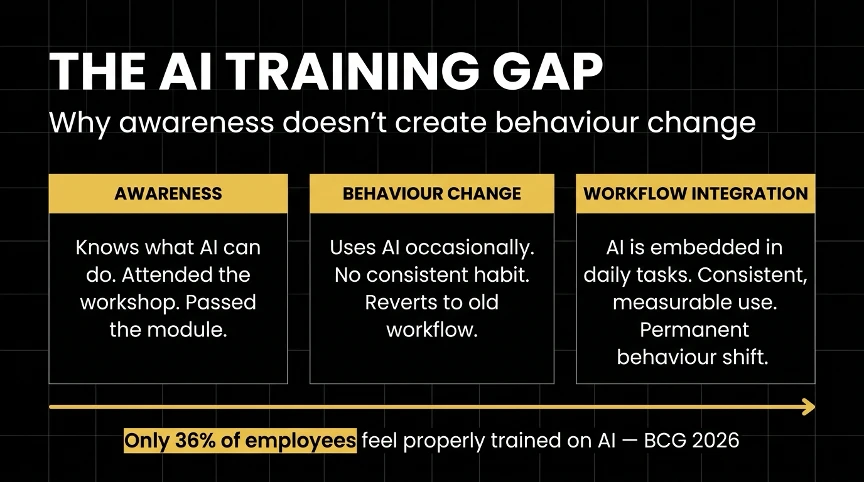
Most AI training is built around one assumption: if we show people what AI can do, they'll use it.
That's not how behaviour change works.
Knowing a tool exists and integrating it into how you work are two completely different things. You can watch a demo, complete a module, even pass a certification — and still never change your workflow.
This is the gap most organisations are funding without realising it.
Why AI Training Doesn't Stick: The 3 Real Reasons
The majority of AI training is structured around tools. Here's what ChatGPT does. Here's how to write a prompt. Here's what Copilot can automate.
The problem: tools without workflow context don't change how people work.
An employee learns to write a better prompt. But if their existing workflow doesn't have a natural insertion point for that prompt, it gets used once and forgotten.
Behaviour change requires a different question: Where in this person's daily workflow does AI actually fit? Most training never asks it.
Training programmes tend to be events. A half-day workshop. A four-module course. A lunch-and-learn.
But AI adoption isn't an event — it's a habit that has to be built over weeks of repeated use.
BCG's data makes this clear: employees with more than 5 hours of structured training are dramatically more likely to become regular AI users. Not because of what they learned in hour 5, but because repeated engagement builds the habit.
A single session creates awareness. It doesn't create capability.
A marketing manager and a finance analyst use AI differently. Their workflows are different. Their outputs are different. Their resistance points are different.
Generic AI training — the kind that tries to work for everyone — ends up being truly useful for no one.
Role-specific training connects AI to the actual decisions, documents, and deliverables of a particular job. It answers the question employees actually have: How does this help me, specifically, in what I do every day?
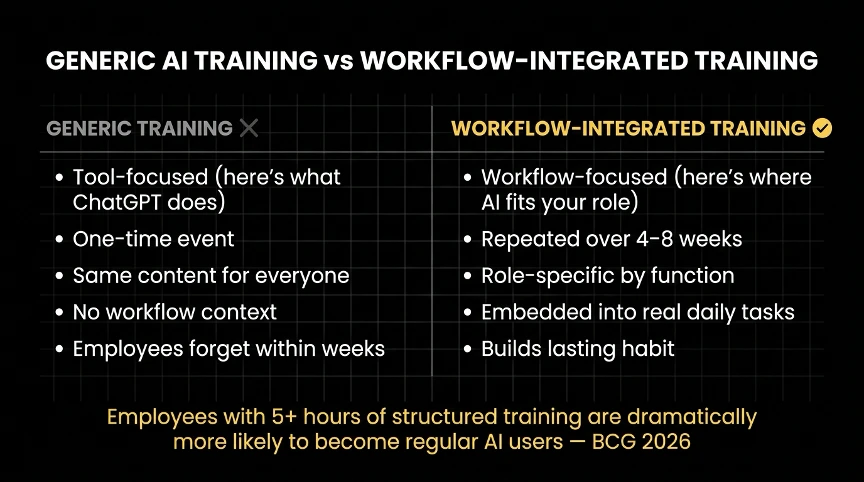
The data paints a clear picture of what works — and what doesn't.
• Only 36% of employees feel properly trained on AI (BCG, 2026)
• 54% of employees say they'd use unauthorised AI tools if corporate solutions fall short (BCG, 2026)
• Employees with clear leadership support have adoption rates of 82%, versus 41% for those without (BCG, 2026)
• A Harvard, MIT, and BCG study found that how employees use AI matters infinitely more than how often
The takeaway: volume of training doesn't drive results. Design of training does.
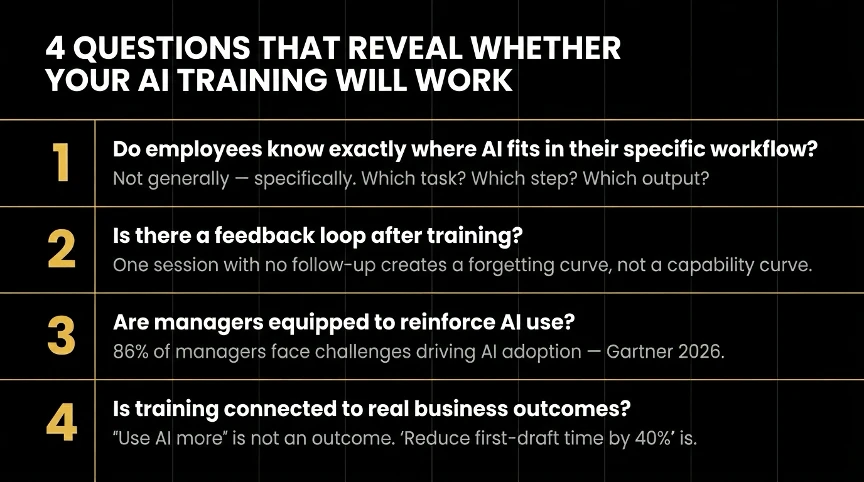
Not generally — specifically. Which task? Which step? Which output? If your team can't answer this with precision, the training didn't connect to their work.
One session with no follow-up creates a forgetting curve, not a capability curve. If nothing reinforces the behaviour in week 2 and week 3, don't be surprised when week 4 looks like week 0.
Gartner's March 2026 research found that 86% of managers face challenges driving AI adoption on their teams — yet most organisations train employees and skip managers entirely.
If you want to go deeper on this, see how manager-specific AI enablement changes adoption outcomes.
'Use AI more' is not an outcome. 'Reduce first-draft time by 40%' is. Without a defined success metric, there's no way to measure whether training is working — and no way to improve it.
Effective AI training isn't a different topic — it's a different structure.
• Start with the workflow, not the tool. Map the tasks your team does daily. Identify the 3–5 highest-friction points. Build training around those specific insertion points.
• Make it role-specific from day one. Segment by function, then by output type.
• Build in repetition and reinforcement. Five hours over three weeks outperforms five hours in one day.
• Equip managers to lead adoption. The single highest-leverage investment isn't training more employees — it's training the managers who sit between strategy and daily execution.
• Define success before you start. What does 'AI-capable' look like for this role in 90 days?
Most organisations treat AI training as an L&D problem. It's not.
It's a workflow design problem. The training fails because the work itself hasn't changed.
For a deeper look at why traditional corporate AI training isn't working in 2026 and what the alternative looks like, that's worth reading next.
Tools don't transform teams. Workflows do.
That's why organisations that invest in redesigning how work happens — not just what tools people have access to — are the ones seeing measurable results.
If your teams have been through AI training but you're not seeing consistent use, the gap isn't knowledge. It's design.
The question worth asking isn't 'did they attend the training?' It's 'did we change how they work?'
Humaine's team enablement programmes are built around workflows — not tools. See how it works.
Because the training didn't change their workflow — it only added new information. Habits are formed through repeated behaviour in context, not through awareness. Without workflow integration, there's no trigger to use AI consistently.
BCG's research suggests that employees who receive more than 5 hours of structured training are significantly more likely to become regular AI users. Consistent use typically takes 4–8 weeks of reinforced practice before it becomes habitual.
Because it answers the question employees actually have: 'How does this help me do my specific job?' Generic training creates awareness. Role-specific training creates behaviour change by connecting AI to the actual tasks and decisions in someone's daily workflow.
Should managers receive different AI training than employees?
Yes. Gartner (2026) found that 86% of managers struggle to drive AI adoption on their teams. Managers need training on how to identify AI use cases for their team, coach employees through the transition, and measure impact — not just how to use AI themselves.