Why Traditional Corporate AI Training Isn't Working in 2026 (And What Does)

Tell us about your team and we'll show you the path forward.
We'll be in touch.
Our team will reach out within 24 hours.

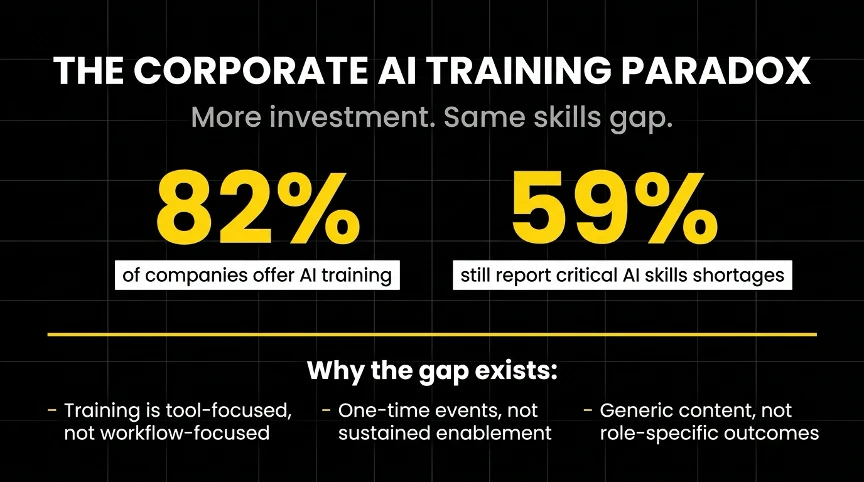
82% of companies now offer AI training.
59% still report critical AI skills shortages.
If corporate AI training that works existed at scale, those two numbers couldn't both be true. But they are — and the gap between them is costing organisations real productivity, real competitive ground, and real money.
The problem isn't that companies aren't investing. They are. The problem is what they're investing in.
Walk into most corporate AI training programmes in 2026 and you'll find a familiar pattern.
A vendor demo. A prompt-writing workshop. A self-paced course on a learning platform. Maybe a lunch-and-learn where someone shows the team what ChatGPT can do.
Tick the box. Move on.
The assumption behind all of it: if employees understand AI tools, they'll use them effectively. That assumption is wrong — and it's why 59% of organisations are still reporting skills shortages after years of training investment.
Understanding a tool and integrating it into how you work are fundamentally different things. Traditional training addresses the first. Almost none of it addresses the second.
Most AI training is structured around what AI can do — features, capabilities, use cases. It's essentially product education delivered at scale.
But employees don't need to understand AI. They need AI to help them do their job better. Those are completely different starting points.
Corporate AI training that works starts with the outcome — a specific role, a specific workflow, a specific result — and works backwards to the tools and prompts that get there.
A single training session creates awareness. It doesn't create capability.
BCG's 2026 research is clear on this: employees with more than 5 hours of structured training are dramatically more likely to become regular AI users. Not because hour 5 contains some secret — but because repeated engagement builds the habit that single sessions can't.
Behaviour change requires repetition over time. Most corporate AI training gives employees one session and calls it done.
A single AI training programme designed to work for your entire organisation will be genuinely useful for almost no one.
A sales manager and a finance analyst have different workflows, different outputs, different resistance points, and different definitions of 'useful.' Generic training can't address any of that with precision.
The result: employees sit through content that technically applies to them but doesn't feel relevant. Engagement drops. Adoption doesn't follow.
Gartner's March 2026 research found that 86% of managers face challenges driving AI adoption on their teams.
Yet most corporate AI training programmes train employees and skip managers entirely.
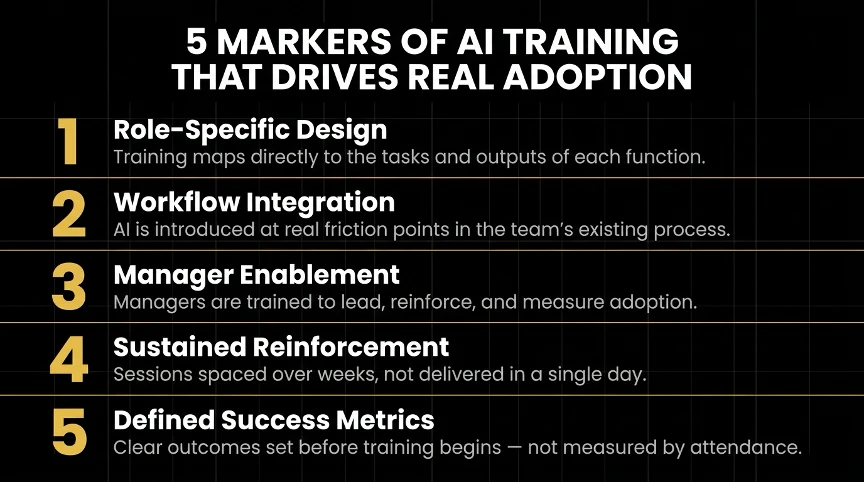
Managers are the adoption layer. They sit between strategic intent and daily execution. If they don't know how to identify use cases, coach adoption, or measure impact — the training investment beneath them leaks out.
Ready to equip your managers? See how Humaine builds manager-specific AI enablement.
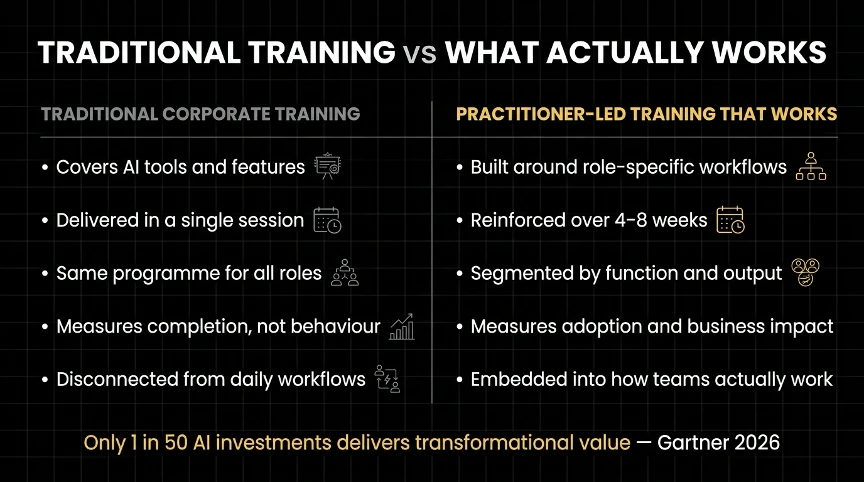
The organisations seeing real results in 2026 aren't doing more training. They're doing different training.
Here's what separates the programmes that drive adoption from the ones that don't.
Effective AI training maps the specific tasks, decisions, and outputs of a role — then identifies where AI creates the most leverage. The tool is chosen to serve the workflow, not the other way around.
When employees see AI solving a real friction point in their actual day, adoption follows naturally. When they see a demo disconnected from their work, it doesn't.
The most effective programmes segment by function and output type. Marketing, operations, finance, and HR each have distinct AI use cases. Training that speaks directly to those specifics drives behaviour change that generic programmes can't.
Five hours of training spread over three weeks consistently outperforms five hours in a single day. Spaced repetition builds habit. Habit drives adoption. Adoption drives results.
Completion rates tell you who showed up. They don't tell you whether anything changed. Effective programmes define success metrics before training begins — time saved, quality improvement, workflow changes — and measure against them.
See how Humaine structures AI enablement with built-in outcome tracking.
Most organisations treat AI training as an L&D problem. A course to deploy. A box to tick. A budget line to justify.
It's not. It's a workflow design problem.
Training fails not because of what's in the curriculum — but because the work itself hasn't changed. If you want to understand why AI training fails to change behaviour, that's where to look.
You can train people on AI all day and lose them the moment they return to processes designed before AI existed.
The companies pulling ahead in 2026 aren't the ones with the most training hours. They're the ones who redesigned how work happens — and built training around that new way of working.
Ask these four questions honestly:
• Do employees know exactly where AI fits in their specific workflow — not generally, but for which task and which output?
• Have managers been trained to lead AI adoption, or just to use AI themselves?
• Is there sustained reinforcement after the initial training, or was it a one-time event?
• Did you define measurable success outcomes before training started?
If the answer to any of these is no, the programme is generating awareness — not capability.
If your teams have been through AI training but adoption hasn't followed, the gap isn't knowledge. It's design.
The question isn't whether to train. It's whether the training is built around how your teams actually work — or around what AI tools can technically do.
Humaine builds practitioner-led AI training programmes that start with your team's workflows and end with measurable adoption. Not another workshop. A capability shift. See how it works.
Most corporate AI training is tool-focused, generic, and delivered as a one-time event. It creates awareness but doesn't change how people work. The result: employees know AI exists and what it can do, but never integrate it into their daily workflows. Real adoption requires role-specific, workflow-embedded, sustained training — not product demos at scale.
Effective AI training starts with the workflow, not the tool. It maps specific tasks and outputs for each role, identifies real friction points, and introduces AI precisely where it creates leverage. It's segmented by function, reinforced over weeks rather than delivered in one session, and measured by adoption and business outcomes — not completion rates.
BCG's 2026 research shows that employees with more than 5 hours of structured training are significantly more likely to become regular AI users. But it's not about hours — it's about spacing. Training spread over 4–8 weeks with reinforcement and practice time builds the habits that single-day sessions can't. Think programme, not event.
Yes — and most organisations are getting this wrong. Employees need role-specific workflow training. Managers need something different: how to identify AI use cases for their team, how to coach adoption, how to measure impact. Gartner (March 2026) found that 86% of managers face challenges driving AI adoption. Until managers are equipped to lead it, employee-level training will always underdeliver.
Define success before training starts. Generic metrics like 'engagement' or 'satisfaction scores' don't capture adoption. Effective measurement looks at: consistent AI usage rates over 30/60/90 days, time saved on specific tasks, quality improvements in outputs, and whether AI use has become embedded in team workflows. The organisations seeing real AI ROI set these targets before the first session — not after.