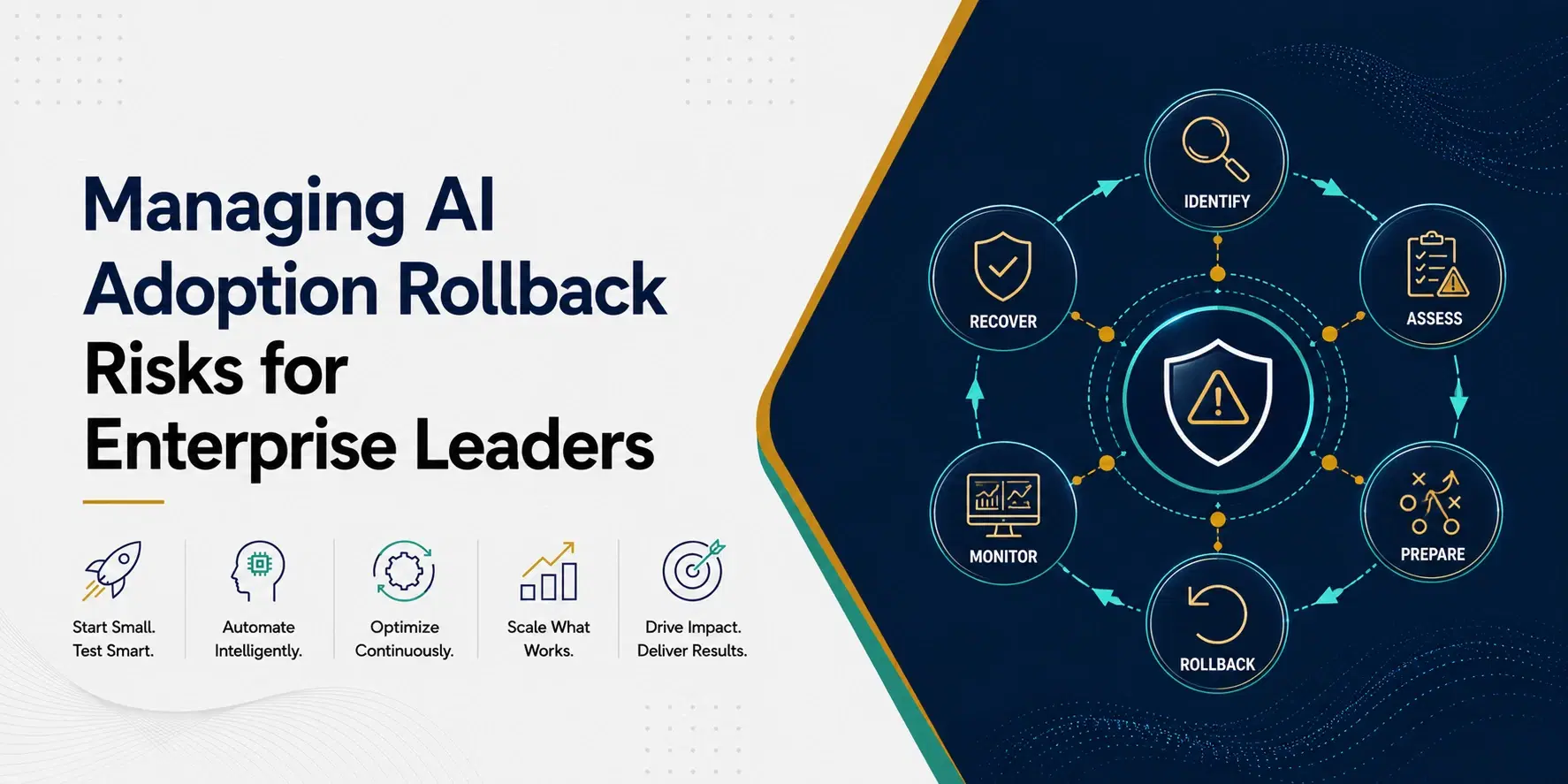
Managing AI Adoption Rollback Risks for Enterprise Leaders

Tell us about your team and we'll show you the path forward.
We'll be in touch.
Our team will reach out within 24 hours.

74% of enterprises have already rolled back an AI agent after deployment due to governance failures. This isn't a statistic about early adopters or experimental pilots—it includes 81% of organizations with "fully mature" AI programs. The conventional wisdom treats rollback as failure, but the data reveals something more fundamental: in an environment where 74-80% of AI initiatives fail to deliver measurable value, rollback isn't the exception—it's the primary risk management tool most enterprises never planned to use.
TL;DR
Rollback is statistically normal: With 74-80% of AI initiatives failing across BCG and RAND studies, every deployment should be designed with rollback as a planned capability, not an emergency response.
Capability gaps drive most failures: Only 6% of companies have trained more than 25% of their workforce on AI, creating the awareness-without-capability gap that kills pilots.
Governance failures trigger forced rollbacks: Organizations that scale without establishing data handling, privacy, and escalation protocols face the highest rollback rates.
Measurement frameworks must precede deployment: 28% of completed AI projects deliver no measurable value because success criteria weren't defined before launch.
Strategic rollback prevents catastrophic failure: Companies that treat rollback as risk management rather than defeat position themselves to re-enter with modifications rather than abandon AI entirely.
The Sinch study revealing 74% enterprise rollback rates represents more than vendor-reported statistics—it exposes the gap between AI deployment enthusiasm and operational reality. BCG's parallel research across 1,000 CxOs in 59 countries found that 74% of companies struggle to achieve and scale value from AI, while RAND Corporation data shows approximately 80% of AI projects fail outright. These aren't three separate problems. They're three measurements of the same phenomenon.
The pattern becomes clearer when examining the RAND breakdown: 33.8% of projects are abandoned before production, 28.4% complete but deliver no measurable value, and 18.1% cannot justify their costs. The Sinch finding that mature AI programs have higher rollback rates (81% versus 74% overall) initially appears counterintuitive. But mature programs deploy more agents, creating more rollback opportunities.
This convergence of independent data sources points to a fundamental misunderstanding about AI adoption risk. Most enterprise leaders plan for deployment success and treat rollback as an unplanned failure state. But when failure rates consistently exceed 70% across multiple studies, the organizations treating rollback as an emergency response are the ones operating without a strategy.
The BCG study reveals that only 6% of companies have trained more than 25% of their workforce on AI. This statistic explains why the Sinch rollbacks cluster around governance failures rather than technical malfunctions. When organizations deploy AI tools to teams that lack the capability to use them properly, the resulting governance failures—data mishandling, inappropriate outputs, security breaches—become inevitable.
The 2025 abandonment data showing 42% of companies scrapping most AI initiatives (up from 17% in 2024) cites data security, privacy risks, and costs as primary drivers. These aren't technology problems. They're capability problems manifesting as governance crises. Teams that don't understand AI's limitations will use it inappropriately. Teams that don't understand data handling will create security vulnerabilities. Teams that don't understand cost structures will deploy expensive solutions to cheap problems.
RAND's finding that 28.4% of AI projects complete but deliver no measurable value reveals the same capability gap from a different angle. These projects didn't fail technically—they failed because the organization lacked the capability to define success criteria, measure outcomes, or integrate AI outputs into existing workflows. The technology worked. The humans didn't know how to work with the technology.
This capability-driven failure pattern explains why generic AI training programs consistently fail to prevent rollbacks. Awareness without role-specific, function-specific capability building creates the illusion of readiness while leaving the fundamental risk factors unchanged.
The Sinch data showing governance failure as the primary rollback trigger reveals a specific sequence: organizations deploy AI tools before establishing clear policies on data handling, output quality, escalation procedures, and accountability structures. When incidents occur—and they will occur—the absence of governance frameworks forces immediate rollback rather than managed response.
BCG's research shows AI leaders invest significantly more in governance and cross-functional alignment than laggards. This isn't correlation. Organizations that establish governance frameworks before scaling can respond to incidents with policy adjustments rather than emergency shutdowns. Organizations that scale first and govern later face binary choices: continue operating with unacceptable risk or roll back entirely.
The governance gap becomes particularly acute in regulated industries where data security and privacy violations carry legal and financial consequences. The 2025 abandonment data citing security and privacy as top rollback drivers reflects organizations discovering—post-deployment—that their AI implementations violate compliance requirements they should have addressed during design.
Consider the cascade: an organization deploys an AI customer service agent without establishing clear escalation protocols. The agent provides incorrect information to customers. Customer service representatives don't know when to override the agent or how to report problems. Incidents accumulate. Legal and compliance teams discover the violations. The organization faces a choice between accepting liability or immediate rollback. Without governance frameworks, rollback becomes the only viable option.
RAND's finding that 28% of completed AI projects deliver no measurable value exposes the most dangerous rollback risk: organizations that cannot distinguish between struggling initiatives and failing ones. Without pre-defined success metrics and measurement frameworks, every deployment becomes a judgment call rather than a data-driven decision.
The measurement problem compounds the capability and governance issues. Organizations with capability gaps cannot define realistic success criteria because they don't understand what AI can and cannot deliver. Organizations with governance gaps cannot measure outcomes because they haven't established baseline processes or data collection protocols. When problems emerge, these organizations lack the data to determine whether the solution is rollback, modification, or patience.
BCG's data showing that AI leaders are 2.5 times more likely to have structured measurement frameworks reveals the strategic advantage of measurement-first deployment. These organizations can identify rollback-worthy failures early, before they become expensive disasters. They can also identify slow-to-mature successes and avoid premature rollback of viable initiatives.
The measurement framework must address both technical performance (accuracy, speed, cost) and behavioral adoption (workflow integration, user satisfaction, business impact). Technical metrics without behavioral metrics miss the capability gap. Behavioral metrics without technical metrics miss the governance gap. Organizations that measure only one dimension consistently make incorrect rollback decisions.
The highest-stakes implication of the rollback data isn't that AI initiatives fail—it's that organizations treating rollback as failure will be systematically outcompeted by organizations treating rollback as risk management. When 74-80% of AI initiatives require rollback or abandonment, the competitive advantage belongs to organizations that can rollback strategically, learn systematically, and re-deploy effectively.
The Sinch finding that mature AI programs have higher rollback rates (81%) suggests these organizations have learned to rollback proactively rather than reactively. They've developed the governance frameworks, measurement systems, and organizational capabilities to identify rollback-worthy situations before they become crises. This isn't failure—it's sophisticated risk management.
The strategic rollback framework requires three capabilities most organizations lack: parallel-run architectures that allow rollback without operational disruption, root-cause analysis processes that distinguish technology failures from capability failures, and re-entry protocols that define conditions for modified re-deployment. Organizations that build these capabilities can treat AI adoption as an iterative learning process rather than a binary success-or-failure bet.
The competitive implications are profound. Organizations that fear rollback will under-deploy AI, missing productivity gains and market opportunities. Organizations that ignore rollback risk will over-deploy AI, creating governance crises and capability gaps that force expensive emergency responses. Organizations that plan for strategic rollback can deploy aggressively, learn quickly, and scale systematically.
The enterprise AI rollback data reveals a fundamental strategic choice: organizations can continue treating 74-80% failure rates as a deployment problem, or they can recognize rollback as the primary tool for managing AI adoption risk in an environment where failure is statistically normal.
The evidence from BCG, RAND, and Sinch converges on a clear pattern: organizations that invest in capability building, governance frameworks, and measurement systems before scaling can use rollback strategically. Organizations that scale first and address these factors later face forced rollback as an emergency response. The difference isn't just operational—it's competitive.
The question isn't whether your AI initiatives will face rollback pressure. The question is whether you'll be ready to use rollback as a strategic tool rather than suffer it as an unplanned failure.
1. BCG. (2024, October 24). "Where's the Value in AI?" Survey of 1,000 CxOs across 59 countries. BCG Press Release.
2. RAND Corporation. Report RR-A2680-1. AI project failure rate analysis.
3. Sinch AB. (2026, May 13). "The AI Production Paradox." Sinch Press Release.
4. Pivot to AI. (2025, April 1). "AI in the Enterprise is Failing Over Twice as Fast in 2025 as it was in 2024."
5. NMBLR.ai. (2025). "Everyone Has AI, Almost Nobody Has It Under Control." Featured Insight.