
What an AI-First Operating Model Actually Looks Like (And Why Most Organisations Are Still Building the Wrong One)


Two organisations. Both have AI tools deployed across their teams. Both have usage metrics that look healthy. But one is building a structural competitive advantage. The other is running the same organisation faster.
The difference is not the tools. It is the operating model underneath them.
Most enterprise AI investment is going into what might be called AI-optimised operations: existing structures, roles, and processes with AI tools layered on top. It is faster. It produces productivity gains at the margin. And it creates the appearance of transformation without the substance of it.
The organisations that will hold a structural advantage in three years are building something different: an operating model where AI is not an addition to how work gets done, but a core component of how it is designed.
The distinction matters more than it might appear.
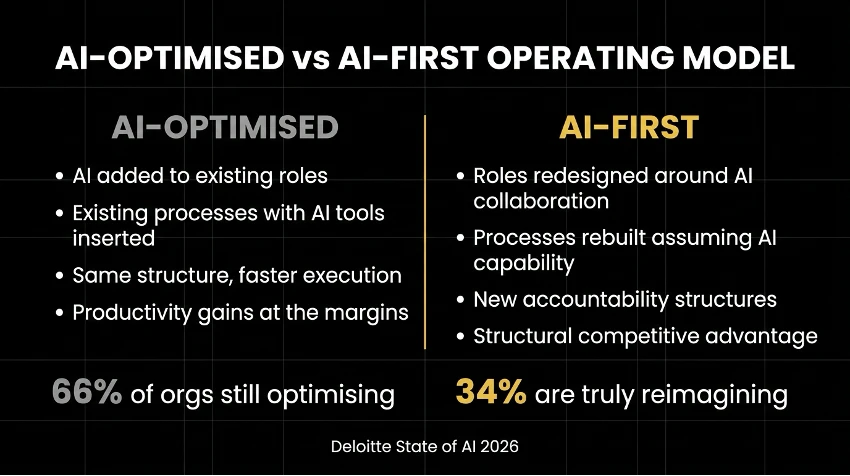
An AI-optimised organisation deploys tools into existing roles and processes. The account manager still runs the same calls, writes the same reports, manages the same handoffs — just with AI assistance at certain points. The workflow is intact. AI has been inserted into it.
An AI-first organisation asks a different question before any tool goes in: if we were designing this role, this process, or this team from scratch today, knowing what AI can do, what would it look like?
That question produces different answers. It surfaces assumptions embedded in the workflow that only exist because of pre-AI constraints. It identifies which steps exist for legacy reasons and which create genuine value. And it produces workflow redesign as precondition for AI deployment where AI’s capabilities are assumed from the start, not bolted on afterward.
Deloitte’s 2026 State of AI research makes the gap concrete: 66% of organisations are still in the AI-optimised zone, using AI to improve existing operations. Only 34% are genuinely reimagining how the business operates. That 34% is where structural competitive advantage lives.
What an AI-First Operating Model Actually Contains
An AI-first operating model is not a technology architecture. It is an organisational design decision — and it has five defining features.
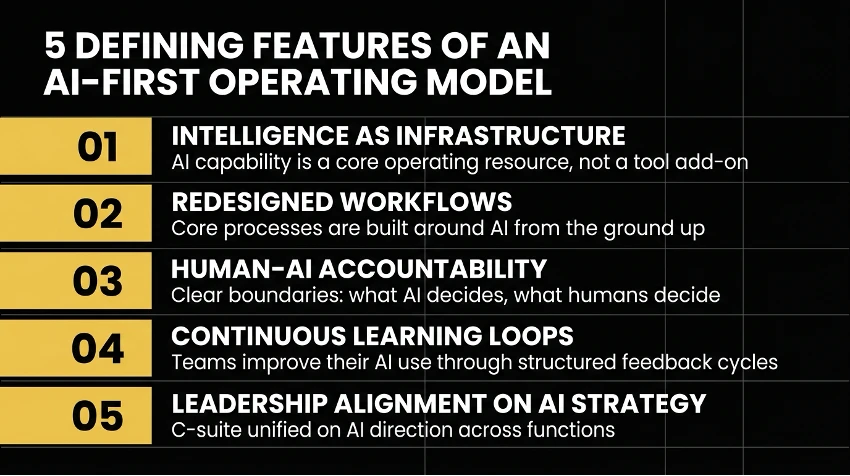
In an AI-first organisation, AI capability is treated as a core operating resource — like finance, data, or people. It is provisioned at the organisational level, not left to individuals to source. Teams know what AI capability they have access to, how to deploy it, and who is accountable for ensuring it works. It is infrastructure, not a perk.
Core processes are not optimised with AI. They are rebuilt assuming AI capability exists. This is not a subtle distinction. A workflow built for AI handles handoffs differently, has different decision points, requires different human inputs, and produces different outputs. The WEF’s 2026 analysis of AI-first operating models identified structural redesign as the real bottleneck separating high-performing AI organisations from the rest.
AI-first organisations define explicitly what AI decides, what AI recommends, and what humans decide. These boundaries are not left to individual judgment — they are built into the operating model. This reduces both risk and cognitive load: teams know where their judgment is required and where AI’s output can be trusted.
Teams are not trained once and expected to maintain their AI capability indefinitely. AI-first organisations build structured feedback cycles into how work is done. BCG’s research confirms that AI-mature organisations seven times more likely to reach AI maturity are those that build AI maturity through structured, ongoing development.
An AI-first operating model requires the C-suite to be unified on what AI transformation means for the organisation, who owns it, and how progress is measured. Without that alignment, different functions build conflicting AI capabilities, investment gets fragmented, and the operating model never coheres.
Why Most Organisations Are Building the Wrong Model
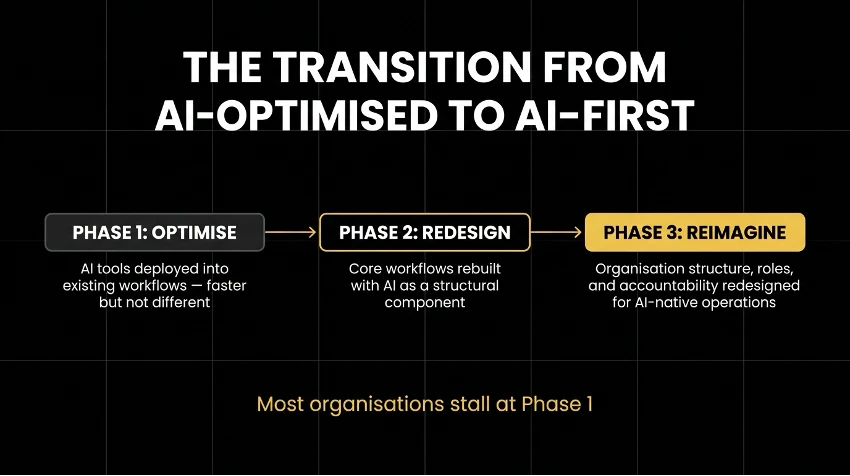
The most common reason organisations land in AI-optimised rather than AI-first is sequencing.
Tools are deployed before the operating model is designed. Pilots run before the workflows are mapped. Training is delivered before the roles are redesigned. Each of these choices feels pragmatic in the moment. In aggregate, they produce an organisation that has AI everywhere and AI-first nowhere.
The WEF’s analysis of structural redesign as the bottleneck points to the same root cause: organisations treat operating model redesign as a later phase, after adoption is proven. But you cannot prove adoption of a model you haven’t built.
• They start with the operating model question before the tool selection question
• They treat workflow redesign as the precondition for tool deployment, not its successor
• They build AI capability at the team level through structured enablement, not individual upskilling
AI-optimised means existing structures, roles, and processes with AI tools added to them. AI-first means the operating model is designed from the ground up with AI’s capabilities assumed — workflows rebuilt, roles redesigned, accountability structures redrawn. The difference is structural, not cosmetic.
Because AI-optimised requires no change management. Tools can be deployed into existing structures without touching workflows, roles, or leadership alignment. AI-first requires redesigning how the organisation works — which is politically complex, resource-intensive, and takes longer to produce visible metrics. Most organisations choose the easier path and find that AI-optimised is a ceiling, not a destination.
Three things: leadership alignment on what AI-first means for the organisation; workflow redesign before tool deployment; and structured AI capability building at the team level that connects to redesigned processes. Without all three, the transition stalls.
Organisations running structured AI enablement programmes see measurable workflow change within 90 days of a well-designed programme start. Full operating model transformation — where AI is embedded across core processes and teams are consistently operating at AI-first depth — typically takes 6–18 months depending on scope and starting point.
Most organisations are building an AI-optimised operating model and calling it AI transformation. It is not.
AI-optimised produces productivity gains at the margin. AI-first produces structural competitive advantage — because the way the organisation works changes, not just the speed at which it does the same things.
The transition requires a sequencing shift: operating model design before tool deployment, workflow redesign before capability building, team enablement before individual upskilling. That sequence is the difference between organisations that will look back at this period as the moment they transformed, and those that will look back and wonder why the investment didn’t produce results.